AI Physics Problem Solver: Step-by-Step Solutions
Physics homework has a cruel structure: if you can't identify which formula applies, you can't even start. A physics problem solver removes that wall — scan the problem and see which principle it's testing, which formula fits, and how the numbers flow through to the answer, units and all.
Why physics needs more than a calculator
Calculators compute; they don't choose. The real difficulty in physics is mapping a situation ('a ball is thrown upward at 12 m/s…') to the governing equations. Math Solver's AI does the mapping visibly: it identifies the concept (projectile motion, Newton's second law, Ohm's law), states the formula, substitutes with correct units, and solves step by step. Seeing the concept-to-formula mapping over and over is how physics finally clicks.
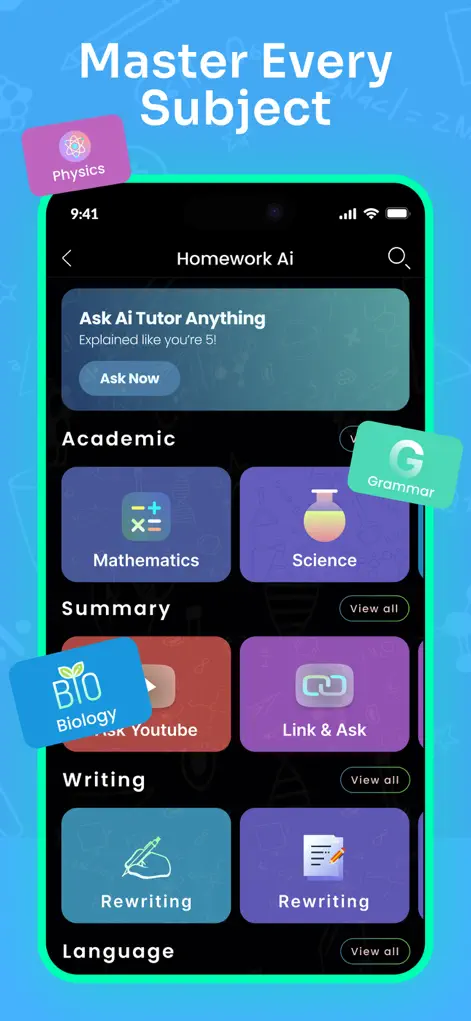
Step-by-Step: AI Physics Problem Solver: Step-by-Step Solutions
- Scan the full problem. Include the given values and the question — the AI needs both to pick the right approach.
- Check the identified concept. The solution names the principle being applied. If it says 'conservation of energy' and you expected kinematics, you've just learned something important.
- Follow formula → substitution → answer. Each step shows the equation, the plugged-in values with units, and the arithmetic.
- Drill the concept with the AI tutor. Ask for a similar example or a plain-language explanation of the principle to lock it in.
Physics problems that suit the solver, and ones that need extra care
Numerical problems with stated values do well: kinematics, forces, energy, circuits and waves where the question gives the numbers and asks for one quantity. The concept, formula and units are all on the page, so the solution is easy to verify.
Problems built around a drawing need more care. Free-body diagrams, circuit drawings and motion graphs hold information the solver may not read fully, so write the key values and directions as text next to the scan. Questions that ask you to explain or sketch something are better handled with the AI tutor and then written up in your own words.
Checks to run on any physics answer
A physics answer can be arithmetically correct and still wrong. These checks take seconds and catch most problems, whether the working is yours or the app's.
- Sign and direction: choose a positive direction at the start and make sure velocities, forces and accelerations follow it.
- Units: convert to SI units before substituting, such as grams to kilograms and km/h to m/s.
- Size: ask whether the number is realistic. A walking speed of 50 m/s or a classroom resistor drawing thousands of amps means something slipped.
- Assumed values: note any constant the solution used, like g = 9.8 m/s², and check it matches the value your course uses.
Try It on Your Next Assignment
Math Solver: AI Homework Helper is free to download on the App Store. Scan your first problem in seconds.
⬇ Download Math SolverFrequently Asked Questions
Which physics topics does it cover?
Mechanics, kinematics, forces, energy, waves, electricity and circuits, and other standard high school and intro college topics.
Does it handle units correctly?
Yes — substitutions carry units, and you can ask for conversions if the answer needs different units.
Can it explain the underlying concept, not just solve?
Yes, ask the AI tutor to explain the principle behind any solution at your level.