Chemistry Homework Help with AI
Chemistry homework compounds: miss the mole concept in week three and everything after it wobbles. AI chemistry help works because it's always available at the exact problem you're stuck on — scan a stoichiometry exercise or an unbalanced equation and get the worked solution plus the reasoning.
Where AI helps most in chemistry
Chemistry mixes three kinds of difficulty: symbolic (balancing equations), computational (stoichiometry, molarity), and conceptual (why reactions happen). Math Solver covers all three — it balances equations showing the coefficient logic, works mole-ratio calculations step by step, and its AI tutor explains concepts like electronegativity or equilibrium in plain language when the textbook definition doesn't land.
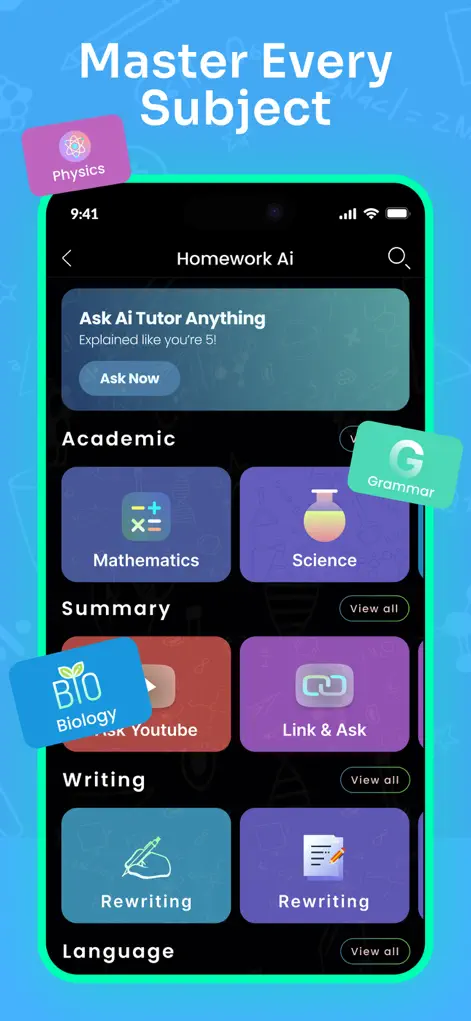
Step-by-Step: Chemistry Homework Help with AI
- Scan the chemistry problem. Equations, stoichiometry exercises, gas-law calculations — frame the whole problem.
- Follow the worked solution. For balancing: see which element forced each coefficient. For stoichiometry: watch the mole-ratio chain from given to asked.
- Ask the 'why' questions. Use the AI tutor for the conceptual layer: 'why does this reaction produce a gas?' or 'what makes this acid strong?'
- Redo one variant yourself. Change one number in the problem and solve the variant on paper — the fastest self-test that the method stuck.
What to scan and what to type in chemistry
Balancing equations, stoichiometry, molarity and gas-law calculations suit the scanner well when the formulas are written clearly. Subscripts, charges and state symbols are small, so photograph them close up in good light and check the recognized formula before solving. One misread subscript turns H2O2 into H2O and changes the whole problem.
Structural diagrams, reaction mechanisms drawn with arrows, and questions based on lab data tables are harder to read from a photo. Type out the relevant formulas and values instead, or describe the structure and ask the AI tutor about the concept. Lab reports and conclusions should come from your own results.
Mistakes that cost the most marks in chemistry homework
Chemistry errors tend to repeat, and the worked steps make them easy to spot if you know where to look. When your answer differs from the app's, check these before assuming your whole method is wrong. Writing units on every line of your own working makes most of them show up on their own.
- Changing subscripts to balance an equation. Only the coefficients in front of formulas can change.
- Putting grams into a mole ratio. Convert to moles first, apply the ratio, then convert back if the question wants a mass.
- Skipping the limiting reagent. When two reactant amounts are given, work out which runs out first.
- Using milliliters in molarity. Concentration is moles per liter, so divide mL by 1,000.
- Rounding too early. Carry extra digits and round once at the end to the significant figures your teacher asks for.
- Leaving gas-law temperatures in Celsius. They must be in kelvin.
Try It on Your Next Assignment
Math Solver: AI Homework Helper is free to download on the App Store. Scan your first problem in seconds.
⬇ Download Math SolverFrequently Asked Questions
Can it balance chemical equations?
Yes — with the working shown, so you see why each coefficient is what it is.
Does it cover stoichiometry and molarity calculations?
Yes, full step-by-step mole-ratio and concentration calculations.
Can it explain periodic table trends?
Yes — ask the AI tutor about electronegativity, atomic radius, ionization energy, and other trends in plain language.