How Parents Can Check Math Homework — Without Re-Learning Algebra
'Can you check my homework?' is a simple question with a complicated answer when the homework is systems of equations and your last algebra class was decades ago. You don't need to re-learn it. Scan the problem, and Math Solver gives you the correct answer and the worked steps — turning you from a rusty solver into an effective checker.
The parent's real job isn't solving — it's locating
Your child doesn't need you to do the math; they need help finding where their attempt went wrong. With the app's step-by-step solution next to your child's working, the divergence point is visible even if you couldn't produce the solution yourself: the steps match, match, match — then don't. That spot is the misunderstanding, and pointing to it is genuinely useful parenting.
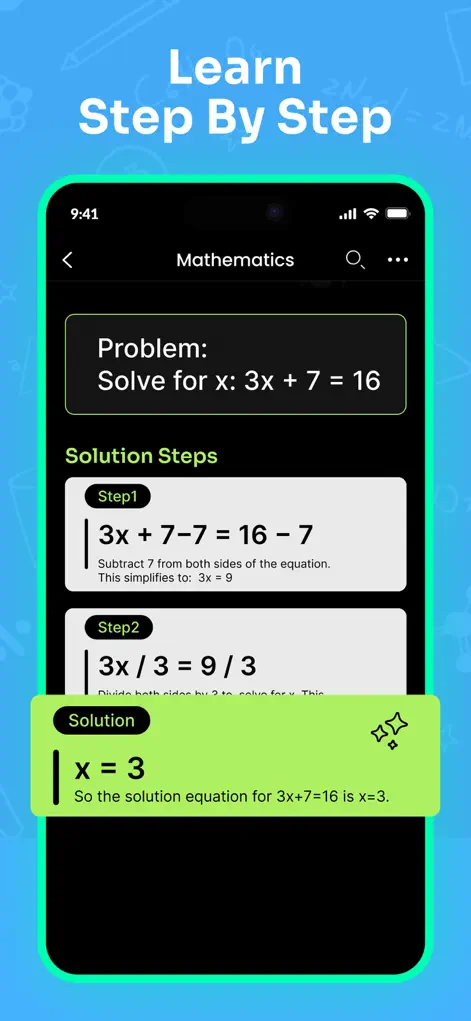
Step-by-Step: How Parents Can Check Math Homework — Without Re-Learning Algebra
- Scan the problem from the worksheet. Get the app's answer and full working first, before looking at your child's.
- Compare answers. If they match — praise and move on. If not, don't say the right answer yet.
- Find the divergence step together. Walk down the app's steps alongside your child's working until they stop matching. Ask 'what happened here?' and let them spot it.
- Let them re-solve. Have them redo the problem from the divergence point. Fixing their own error is worth ten corrected answers.
When the app is a good check, and when to ask the teacher
Scanning works best on clearly written worksheet problems with a single numerical answer or equation. Comparing steps is straightforward there, even when the math is unfamiliar to you.
It is less useful when the class is taught a particular method. Elementary and middle school math often uses specific strategies, such as number lines or area models, and the app's working may take a different route to the same answer. If your child's method looks strange but the answer matches, it is probably the classroom method. When the app and your child disagree and neither of you can see why, send the question to the teacher rather than deciding who is right.
Keeping homework help short and calm
The goal is independent work, so your part should shrink over time. A simple routine helps.
- Let your child finish the whole assignment before you check anything.
- Check a few problems rather than every one, picked from different sections.
- When something is wrong, say which problem, not which step, and give them a chance to find it.
- If they're stuck after a real attempt, open the steps together and stop at the first one they can't explain.
- Keep the phone with you, not them, during the first attempt.
Try It on Your Next Assignment
Math Solver: AI Homework Helper is free to download on the App Store. Scan your first problem in seconds.
⬇ Download Math SolverFrequently Asked Questions
Do I need to understand the math myself?
No — comparing your child's steps against the app's worked solution lets you locate errors without solving anything.
What grade levels does this work for?
From elementary arithmetic through high school algebra, geometry, and beyond.
Is it okay for kids to use the app themselves?
Yes, as a learning tool: checking work, studying steps, and asking the AI tutor — the same healthy usage this guide teaches.